
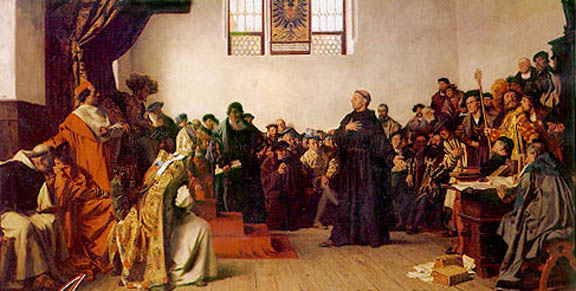
Happy Counter-Reformation Day: Extra Ecclesiam Nulla Salus!
By Shaun Kenney | Monday, October 31st, 2011 | Catch-AllAndrew Schwarz erroneously links the United Nations and the Catholic Church in an attempt to compare carbon credits with — wait for it — indulgences. The link being, necessarily, that blind faith in climate change is comparable to… well… you know… those papists trying to throw us back into an age of mysticism.
Or something like that.
The key takeaway that is lost isn’t so much that Martin Luther “liberated” anything. Luther correctly addressed the institutional abuse of the Catholic Church, but incorrectly applied this to the workings of the Church as a whole. In fact, in the papal bull condemning Luther’s errors, only 43 of the 95 theses were singled out as erroneous… ones that Luther, on a point of conscience in the tradition of humanists such as St. Thomas More and Erasmus, could not bring himself to recant.
I need not go through blood and terror that sprang forth. Nor need I remind anyone that the corruption of the Christian faithful still exists in Protestant and Catholic denominations alike. Far from liberating Christianity, Luther himself rejected much of what he had wrought closer to his death — Luther never desired separation from the Catholic Church, only it’s reform.
Still, the political machinations that drove much of the Protestant Reformation and the subsequent Catholic Restoration radically altered the desires of Martin Luther and countless other “reformers of the reform” since.
Bringing the point back to “climate change” and other political religions of the day…
Perhaps — like Luther — there is a point to the challenge of climate change. Are humans causing it? Is there science behind the claims? Is that science “settled” or is there a body of work that can debate the merits?
Challenges to the established order of things — whether it is climate scientists approaching the public, or Martin Luther and the Diet of Worms — must be taken in their context, and whether the changes being asked for are really in a search for truth, or whether there is a more political, divisive content behind it.
Luther’s concerns were most certainly twisted for political advantage, much as “climate change” today is being twisted. The Wars of the Reformation cost over 8,000,000 lives… something when compared next to vilified experiences such as the Inquisition at 4,000 lives seems to pale in significance. This was not Luther’s vision of a reformed Christianity, but rather a mauled, twisted perversion of it.
Today’s efforts — at the United Nations and elsewhere — to enforce a reform of environmental practices do have a cost. Ask any farmer about the quality of fertilizers today, or any business trying to comply with EPA regulations, or even your average county planner with regards to wastewater runoff compliance. Environmental reform, much like any sort of perceived reform, has it’s cost.
What is needed, as Luther learned later in life, is a balance struck between the needs for reform and the establishment of the tried and true. Luther eventually rejected the “political religion” he inspired while holding fast to the essential truth that reform was necessary.
It’s important to remember in all of this that Luther was not without his faults. Luther was a virulent anti-Semite in later years, hid the second marriages of supporters, advised followers to “be a sinner and sin boldly; but believe more boldly still” in their daily life, and heavily edited Scripture and removed entire books from the Bible. Yet in his faults, Luther was not one to blindly hold to error. Luther’s feuding with Zwingli over sola Scriptura reveals the Augustinian buried in Luther’s writings. In Luther, we read a profoundly conflicted man — sometimes zealous, but always seeking truth — whose trust in God to bring him to truth was so overwhelming, Luther believed it would shatter all doubt and failings.
Such zeal is what we, as Christians, should be put on guard against. This is the zeal that blinds us to the suffering of others, or perhaps allows us to take fraction of the truth and pursue it to such great ends that we forget everything else.
It is a lesson our more modern friends of the secular left could stand to re-learn as they push other ideologies or “reforms” upon the rest of us.
In this light, the reformers at the United Nations stand to compare themselves more directly to 16th century Lutherans, Calvinists, and Zwinglians than they do with 16th century Catholics. Their “reform” for the sake of their own theses and dogma stands in contrast to the way things are. Yet in the end, much as the Reformation before, the crusaders for climate change will not be able to affect their aim, because they will allow political agendas to influence true reform.
Mr. Schwarz attempts an analogy, but it misses the mark widely. Beware the revolutionaries…
Tags:
About the author
Shaun Kenney is the Chairman of the Fluvanna County Board of Supervisors, former Communications Director for the Republican Party of Virginia, and an active blogger since 2002. Shaun lives in Thomas Jefferson's backyard with his wife, six children, and a modest attempt at a farm in Kents Store, Virginia.


Comments
4 Responses to "Happy Counter-Reformation Day: Extra Ecclesiam Nulla Salus!"
Thursday, December 8, 2011
CONFERENCE OF CATHOLIC BISHOPS OF ENGLAND AND WALES AGREE THAT THERE IS NO VISIBLE BAPTISM OF DESIRE : breakthrough in salvation dogma, back to centuries old interpretation.
Daphne McLeod’s statement over time to reverberate throughout Catholic Church
The Conference of Catholic Bishops of England and Wales (CCBEW) agree there is no visible baptism of desire, it is learnt, they are not to issue a denial.They are in agreement with the statement of the English school teacher. Daphne McLeod said that there can be those saved in invincible ignorance and the baptism of desire and this does not contradict the dogma extra ecclesiam nulla salus.She was not talking theology but making a simple common sense observation.The English bishops have no clarification to issue on her statement and neither on that of the Southwark Vocation Director Fr.Stephen Langley.It follows that implicit baptism of desire and those saved in invincible ignorance are not exceptions to the dogma extra ecclesiam nulla salus.
In the Letter of the Holy Office 1949 to the Archbishop of Boston ,Pope Pius XII referred to ‘the dogma’, the ‘infallible teaching’.The dogma indicates all non Catholics need to convert into the Catholic Church for salvation (to avoid Hell). The dogma does not mention any exceptions such as the baptism of desire or invincible ignorance.Since they are implicit and not visible to us they cannot be defacto exceptions.
So Lumen Gentium 16 (invincible ignorance/good conscience) is not an exception to the dogma.It does not contradict the centuries-old interpretation of outside the church there is no salvation.
In principle (de jure) it is accepted that there can be people saved with the baptism of desire, invincible ignorance, good conscience, imperfect communion with the church, ‘the seeds of the Word’(Vatican Council II). De facto we do not know any such case and so they do not contradict the dogma.They do not contradict the interpretation of the popes, saints and Fr.Leonard Feeney of Boston, who was not excommunicated for heresy. The excommunication of this courageous priest, was lifted during his lifetime without him having to recant.He was disobedient to the Archbishop of Boston who suggested that there was an explicitly-known baptism of desire which was an exception to the dogma.
The Archbishop rejected the traditional defacto-dejure analysis of magisterial texts and used an irrational defacto-defacto philosophical model.
In principle (dejure) we can accept that ‘God has bound salvation to the sacrament of Baptism, but he himself is not bound by his sacraments (CCC 1257).’ and ‘ the fruits of Baptism without being a sacrament ‘(CCC 1258) can be there. These cases are not explicitly known to us. De facto we do not know any such case on earth.
In principle,dejure we can accept that ‘the Church has always held the firm conviction that those who suffer death for the sake of the faith without having received Baptized are baptized by their death,’(CCC 1258) in reality only God can judge these cases. They are de facto known only to God.
Catechumens in principle can receive salvation which ‘ they were not able to receive through the sacrament’ if they die before receiving the baptism of water’(CCC 1259). We accept this dejure. De facto we do not know any case so it does not contradict the dogma or Ad Gentes 7 which says all need to enter the Church with Catholic Faith and the baptism of water.
In principle, dejure ‘every man who is ignorant of the Gospel of Christ and of his Church, but seeks the truth and does the will of God in accordance with his understanding of it, can be saved ‘(CCC 1260). De facto the ordinary way of salvation is Catholic Faith with the baptism of water (Ad Gentes 7, Lumen Gentium 14).
In principle we do not exclude from salvation ‘ all united to the Church only by implicit desire’ (Letter of the Holy Office 1949) and ‘reprove…those who falsely assert that men can be saved equally well in every religion’ i.e every one with no exception needs to convert into the Catholic Church for salvation and there are defacto no exceptions.(Letter of the Holy Office 1949, (cf. Pope Pius IX, Allocution, , in , n. 1641 ff.; also Pope Pius IX in the encyclical letter, , in , n. 1677).
Nowhere in the Letter of the Holy Office is it said that the baptism of desire is visible and so an exception to the dogma extra ecclesiam nulla salus.Neither does Vatican Council II or the Catechism of the Catholic Church make this claim.
The Letter is affirming ‘the dogma’, the ‘infallible statement’i.e the ‘strict interpretation’ of outside the church there is no salvation. It was defined ex cathedra and so it is ‘infallilble’. The Letter also affirms implicit baptism of desire. If implicit baptism of desire is considered explicit and known to us, then the Letter would contradict itself.This would be an irrational defacto-defacto analysis.
Similarly Lumen Gentium 14 says everyone needs to enter the Church, ‘the necessity of faith and baptism’.Lumen Gentium 15 and 16 refer to those saved implicitly and who are not formal members of the Church. They can be saved of course in principle and are defacto not known to us.Specific cases are known only to God. Since they are not explicitly known to us they do not contradict Lumen Gentium 14.Here we are using the defacto-dejure analysis.
If you considered implicit salvation as explicitly known to us then Lumen Gentium 15-16 would contradict Lumen Gentium 14. This would be the defacto-defacto reasoning.
Fr.Leonard Feeney was saying that every one de facto needs to enter the Church for salvation and in principle we do not know any exceptions of the baptism of water etc.
The English Cardinals and bishops recognize that every one needs to enter the Church for salvation and there are no visible cases of the baptism of desire. So those saved with the baptism of desire or in invincible ignorance are not exceptions to the dogma extra ecclesiam nulla salus.
-Lionel Andrades
December 8, 2011. Feast of the Immaculate Conception.
http://eucharistandmission.blogspot.com/2011/12/conference-of-catholic-bishops-of.html
Monday, December 12, 2011
CBCEW ECUMENICAL OFFICERS, CATECHISTS AGREE THAT THE BAPTISM OF DESIRE IS NOT AN EXCEPTION TO THE DOGMA OUTSIDE THE CHURCH THERE IS NO SALVATION
The Conference of Catholic Bishops Conference of England and Wales (CBCEW) ecumenical offfers and catechists agree that the baptism of desire is not an exception to the dogma outside the church there is no salvation.
Since those saved in invincible ignorance are unknown to us there cannot be two interpretations of the dogma, ‘ rigorist interpretation’ and non-rigorist interpretation.The Conference of Catholic Bishops of England and Wales (CBCEW) is back to the centuries old interpretation of the dogma;the only interpretation. The secular media refer to the ‘rigorist interpretation’ of the dogma assuming there is a second interpretation. They assume that the baptism of desire and those saved in invincible ignorance are defacto known to us and so contradict the original interpretation of the dogma extra ecclesiam nulla salus.
Representatives of Churches Together in England and Ireland have been informed of this issue.
Catholics bishops seem to agree with the ‘rigorist interpretation’ of the dogma extra ecclesiam nulla salus.They agree there is no visible baptism of desire and so the baptism of desire and those saved in invincible ignorance are not exceptions to the thrice- defined dogma which Pope Pius XII called an ‘infallible statement’.
These blog posts were sent to representatives of the CBEW asking for their comments.They have been sent to, among others, the:
General Secretariat lorraine.welch@cbcew.org.uk, Department of Dialogue and Unity dialunity@cbcew.org.uk, Department Administrator : grace.applewaithe@cbcew.org.uk
They accept that this is the teaching of the Magisterium.There are no denials. None of them claim that the baptism of desire is visible.
-Lionel Andrades
ENGLISH CATHOLIC BISHOPS CONCEDE THERE IS NO VISIBLE BAPTISM OF DESIRE – LAY CATHOLICS AFFIRM VATICAN COUNCIL II AND THE DOGMA IN MISSION PROGRAMS
http://eucharistandmission.blogspot.com/2011/12/english-catholic-bishops-concede-there.html#links
Thursday, December 8, 2011
CONFERENCE OF CATHOLIC BISHOPS OF ENGLAND AND WALES AGREE THAT THERE IS NO VISIBLE BAPTISM OF DESIRE : breakthrough in salvation dogma, back to centuries old interpretation.
http://eucharistandmission.blogspot.com/2011/12/conference-of-catholic-bishops-of.html
CARDINAL CORMAC MURPHY O’CONNOR AFFIRMS THE DOGMA EXTRA ECCLESIAM NULLA SALUS AND AGREES WITH DAPHNE MCLEOD
http://eucharistandmission.blogspot.com/2011/12/cardinal-cormac-murphy-oconnor-affirms.html
ECCLESSIOLOGY OF ENGLISH BISHOPS HIT BY TWO ERRORS 1) VISIBLE BAPTISM OF DESIRE 2) FR.LEONARD FEENEY EXCOMMUNICATED FOR THE SAME VIEW AS POPES, SAINTS AND DOGMA OUTSIDE THE CHURCH THERE IS NO SALVATION
http://eucharistandmission.blogspot.com/2011/11/ecclessiology-of-english-bishops-hit-by.html
CATHOLIC BISHOPS CONFERENCE OF ENGLAND AND WALES SAYS THOSE SAVED WITH THE BAPTISM OF DESIRE, INVINCIBLE IGNORANCE ARE VISIBLE TO US
http://eucharistandmission.blogspot.com/2011/11/catholic-bishops-conference-of-england.html
ECUMENISM OF THE ENGLISH BISHOPS CONTRARY TO VATICAN COUNCIL II
http://eucharistandmission.blogspot.com/2011/11/ecumenism-of-english-bishops-contrary.html#links
CATHOLIC LAY PROFESSOR AT UNIVERSITA EUROPA DI ROMA AFFIRMS DOGMA EXTRA ECCLESIAM NULLA SALUS
http://eucharistandmission.blogspot.com/2011/10/catholic-lay-professor-at-universita.html
LEGIONARY OF CHRIST PRIEST FR.RAFAEL PASCUAL AFFIRMS CANTATE DOMINO, COUNCIL OF FLORENCE
http://eucharistandmission.blogspot.com/2011/10/legionary-of-christ-priest-frrafael.html
FR.TULLIO ROTONDO AFFIRMS CANTATE DOMINO, COUNCIL OF FLORENCE ON EXTRA ECCLESIAM NULLA SALUS
http://eucharistandmission.blogspot.com/2011/08/frtullio-rotondo-affirms-cantate-domino.html#links
CANTATE DOMINO, COUNCIL OF FLORENCE ON EXTRA ECCLESIAM NULLA SALUS IS DE FIDE AND NOT CONTRADICTED BY VATICAN COUNCIL II- Fr. Nevus Marcello O.P
http://eucharistandmission.blogspot.com/2011/07/cantate-domino-council-of-florence-on.html
BRAZILIAN PRIEST SAYS VATICAN COUNCIL II DOES NOT CONTRADICT DOGMA EXTRA ECCLESIAM NULLA SALUS
http://eucharistandmission.blogspot.com/2011/07/brazilian-priest-says-vatican-council.html#links
CATHOLIC PRIESTS IN ROME AGREE WITH FR.LEONARD FEENEY: THERE IS NO BAPTISM OF DESIRE THAT WE CAN KNOW OF
http://eucharistandmission.blogspot.com/2011/08/catholic-priests-in-rome-agree-with.html#links
DAPHNE MCLEOD’S COMMENT SHOULD BE A WAKE UP CALL FOR SSPX, TRADITIONALISTS AND ENGLISH BISHOPS
http://eucharistandmission.blogspot.com/2011/10/daphne-mcleods-comment-should-be-wake.html#links
LETTER OF THE HOLY OFFICE 1949 WAS CRITICAL OF ARCHBISHOP RICHARD CUSHING
http://eucharistandmission.blogspot.com/2011/11/letter-of-holy-office-was-critical-of.html
IN ANALYSING THE LETTER OF THE HOLY OFFICE 1949 YOU ARE USING A DEFACTO-DEJURE ANALYSIS OR A DEFACTO-DEFACTO ANALYSIS.WHETHER YOU KNOW IT OR NOT YOUR USING ONE OF THE TWO
http://eucharistandmission.blogspot.com/2011/11/in-analysing-letter-of-holy-office-1949.html
CONFUSION OVER THE LETTER OF THE HOLY OFFICE 1949
http://eucharistandmission.blogspot.com/2011/11/confusion-over-letter-of-holy-office.html
REMEMBER THAT THE REPORT BY FR.WILLIAM MOST ON EXTRA ECCLESIAM NULLA SALUS IS NOT THE OFFICIAL TEACHING OF THE CHURCH: IT CONTAINS ERRORS AND HERESY
http://eucharistandmission.blogspot.com/2011/11/remember-that-report-by-frwilliam-most.html
CARDINAL RATZINGER DID NOT VIOLATE THE PRINCIPLE OF NON CONTRADICTION AS CATHOLICS UNITED FOR THE FAITH IMPLY
http://eucharistandmission.blogspot.com/2011/11/cardinal-ratzinger-did-not-violate.html
http://eucharistandmission.blogspot.com/2011/12/ccbew-ecumenical-officers-catechists.html
ARCHBISHOP OF BOSTON CARDINAL RICHARD CUSHINGS LEGACY: FOLLOWERS INCLUDE USCCB, EWTN, CATHOLIC ANSWERS, SSPX, SEDEVACANTISTS MHFM
He assumed the baptism of desire was visible and so contradicted the dogma outside the church there is no salvation. He assumed that those saved with the baptism of desire and in invincible ignorance were known to us and so it contradicts Fr. Leonard Feeney’s traditional interpretation of the dogma extra ecclesiam nulla salus.
Since the time of the Archbishop Cardinal Richard Cushing it is assumed there are two interpretations of the dogma. 1)the rigorist interpretation of Fr. Leonard Feeney, the popes and saints and 2) the non rigorist interpretation. The non rigorist interpretation says everyone needs to enter the Church for salvation except for those in invincible ignorance and the baptism of desire. It is assumed here that the baptism of desire and invincible ignorance are exceptions to the dogma. So this is a ‘new ‘interpretation.
We now know that there is only one interpretation of the dogma, the centuries old interpretation since the baptism of desire and invincible ignorance are not known to us.
It is assumed that Vatican Council II, Lumen Gentium 16 (invincible ignorance, good conscience) is an exception to the dogma. This would be assuming that those saved in invincible ignorance are defacto known to us in particular cases. We know that they are not visible and explicitly known to us but known only to God. So they are not exceptions to the dogma.
De facto everyone needs to enter the Church for salvation. De jure in principle those saved in invincible ignorance and the baptism of desire are known only to God. The baptism of water is explicit. The baptism of desire is implicit.
The Letter of the Holy Office 1949 was addressed directly to the Archbishop of Boston. It was critical of the Archbshop. It mentioned ‘the dogma’, the ‘infallible statement’. The dogma does not mention any exceptions. The dogma also indicates, like Fr. Leonard Feeney, that everyone needs to explicitly enter the Church for salvation.
Today the USCCB (United States Conference of Catholic Bishops), Eternal Word Television Network, Catholic Answers, Society of St. Pius X, Pontifical seminaries and universities, sedevacantists, priests, nuns and lay Catholics are all unknowingly following the legacy of the Archbishop of Boston and the Jesuits of Boston College.
They assume the baptism of desire etc is visible and so is an exception to the dogma.
Sunday, February 19, 2012
VATICAN CURIA MUST REALIZE THAT ALL THE POPES HELD THE RIGORIST INTERPRETATION OF EXTRA ECCLESIAM NULLA SALUS
Invincible ignorance and the baptism of desire are not exceptions to the dogma.
There can be no explicit, defacto, known cases of persons saved in invincible ignorance and the baptism of desire. So it is not an issue with respect to the dogma, unless, it is made an issue and made to appear as explicit and known.
Here are the popes affirming the literal interpretation of extra ecclesiam nulla salus.
POPE PIUS IX (Allocution December 9th, 1854)
Pope Pius IX held the rigorist interpretation of the dogma extra ecclesiam nulla salus and also affirmed the possibility of non Catholics being saved in invincible ignorance, cases of which are unknown to us and so are not explicit exceptions to the dogma.
Pope Pius IX was saying: (Defacto):’We must hold as of the faith, that out of the Apostolic Roman Church there is no salvation; that she is the only ark of safety, and whosoever is not in her perishes in the deluge…’ and (Dejure): ‘we must also, on the other hand, recognize with certainty that those who are invincible in ignorance of the true religion are not guilty for this in the eyes of the Lord…’
Defacto (explicitly) everyone needs to enter the Church for salvation (to avoid Hell) and de jure (in principle) and known only to God, there could be non Catholics saved in invincible ignorance etc, ‘in certain circumstances’ (Letter of the Holy Office 1949).
QUANTO CONFICIAMUR
(Defacto) 8. ‘… no one can be saved outside the Catholic Church – Quanto Conficamur, Pope Pius IX 1863
(Dejure) 7. ‘… those who are struggling with invincible ignorance about our most holy religion. Sincerely observing the natural law and its precepts inscribed by God on all hearts and ready to obey God, they live honest lives and are able to attain eternal life by the efficacious virtue of divine light and grace. Because God knows, searches and clearly understands the minds, hearts, thoughts, and nature of all, his supreme kindness and clemency do not permit anyone at all who is not guilty of deliberate sin to suffer eternal punishments…-Quanto Conficamur
LETTER OF THE HOLY OFFICE 1949
The Letter of the Holy Office 1949 issued during the pontificate of Pope Pius XII mentions ‘the dogma’, the ‘infallible statement’.
Here is the ‘dogma’:
(Defacto) ‘… it is absolutely necessary for the salvation of every human creature to be subject to the Roman Pontiff.” (Pope Boniface VIII, the Bull Unam Sanctam, 1302.)
‘… none of those existing outside the Catholic Church… can have a share in life eternal… unless before death they are joined with Her… No one… can be saved, unless he (Defacto) remain within the bosom and the unity of the Catholic Church.” (Pope Eugene IV, the Bull Cantate Domino, 1441.) http://catholicism.org/category/outside-the-church-there-is-no-salvation
(Dejure) ‘… when a person is involved in invincible ignorance God accepts also an implicit desire…’
These things are clearly taught in that dogmatic letter which was issued by the Sovereign Pontiff, Pope Pius XII, on June 29, 1943, (AAS, Vol. 35, an. 1943, p. 193 ff.). For in this letter the Sovereign Pontiff clearly distinguishes between those who are actually incorporated into the Church as members,(Defacto) and those who are united to the Church only by desire (Dejure).- Letter of the Holy Office 1949 (Emphasis added).
VATICAN COUNCIL II
(Defacto) ‘The Church…is necessary for salvation… faith and baptism…for through baptism as through a door men enter the Church.’- Lumen Gentium 14, Vatican Council II.
(Dejure) ‘…those who have not yet received the Gospel are related in various ways to the people of God…’ -Lumen Gentium 16
‘Those also can attain to salvation who through no fault of their own do not know the Gospel of Christ or His Church…’- Lumen Gentium 16
If one uses the irrational defacto-defacto analysis of the above magisterial texts instead of the traditional dejure-defacto interpretation it would mean the popes contradicted themselves and that Vatican Council II contradicted an ex cathedra dogma. It would be a criticism of the infallibility of the popes ex cathedra. It would also be contrary to the Principle of Non Contradiction. It is heresy to claim that there are defacto exceptions to the dogma extra ecclesiam nulla salus.
With the defacto-dejure analysis we see that the Magisterial texts affirm the centuries-old interpretation of the Church Fathers, the saints, the popes and Councils, including Vatican Council II. This was the traditional interpretation of Fr. Leonard Feeney of Boston. This is the teaching of Pope John Paul II’s Dominus Iesus (20) and the Catechism of the Catholic Church 845,846 and also during the pontificate of Pope Benedict XVI in Responses to Some questions regarding certain Aspects of the Doctrine on the Church (2007).-Lionel Andrades
_____________________________________________
Leave your response
The comments section is for meaningful discussion. Readers are reminded to post comments that are germane to the article and write in a common language that steers clear of personal attacks and/or vulgarities.
Please take a moment to review our comment policy.