
As expected, census does little for Virginia; might help GOP overall
By | Wednesday, December 22nd, 2010 | Politics

Back in October, I wrote for the magazine:

Election Data Systems, a Manassas-based political consulting firm that specializes in redistricting and analyzing census data, says that Texas is expected to gain four seats, Florida two, and Arizona, Georgia, Nevada, South Carolina, Utah and Washington will pick up a seat apiece. Meanwhile, New York and Ohio are each losing two seats, and Illinois, Iowa, Louisiana, Massachusetts, Michigan, Missouri, New Jersey, and Pennsylvania will lose one.

It doesn’t take a rocket scientist, let alone a political scientist, to see that House seats are being picked up in “red states” (Republican-leaning) and are being lost in “blue states” (Democratic-leaning). Yet just because the state leans a certain way in presidential elections doesn’t mean the seats themselves will be drawn to favor Republicans. Having at least one branch of government in Republican control, such as the governor, tends to ensure a greater degree of fairness and balance in the process.

Based on yesterday’s Census Announcement, that’s pretty darn close. Dan McLaughlin writes at RedState.com:

By and large, the news was good for the GOP. For the immediate impact, I’ll focus on the Electoral College, although it’s worth noting how many of the redistricting states – especially the two biggest gainers, Texas (+4) and Florida (+2), and one of the two biggest losers, Ohio (-2) – are now under heavy GOP control (and the GOP just recently took control of the NY State Senate, assuring a place at the table in the other state losing more than one seat, as NY is also -2).

Of course, it does nothing for Virginia. Despite growing in population, we didn’t grow fast enough and are still stuck at 13 electoral votes.

Brian Schoeneman, in our next magazine, writes extensively about redistricting and how Virginia is going to handle the situation. If you haven’t subscribed to receive your free issue yet, be sure to do so today.
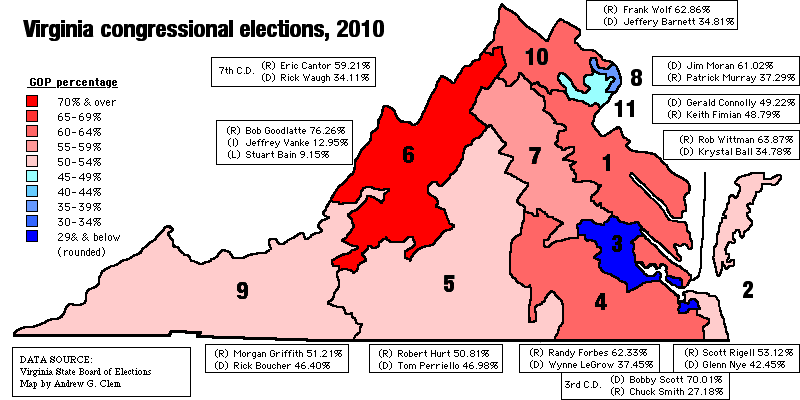
Here’s a sneak preview:

A quick look at the estimated variances from target population across Virginia make it clear that the Congressional districts we have come to know are going to see some major changes. The districts need to gain or lose the following number of people in order to meet the estimated 717K people each Virginia district should possess:

  • 1st (Rob Wittman-R): -36K
  • 2nd (Scott Rigell-R): +57K
  • 3rd (Bobby Scott-D): +60K
  • 4th (Randy Forbes-R): -20K
  • 5th (Robert Hurt-R): +38K
  • 6th (Bob Goodlatte-R): +23K
  • 7th (Eric Cantor-R): -66K
  • 8th (Jim Moran-D): +33K
  • 9th (Morgan Griffith-R): +67K
  • 10th (Frank Wolf-R): -132K
  • 11th (Gerry Connolly-D): -24K

Northern Virginia sources tell Bearing Drift that the most likely outcome here would be for the 11th to shed some of its more Democratic precincts into the 8th District, while possibly gaining some more Republican voters from the 10th. The 10th will have to lose some of its western portions into Bob Goodlatte’s district.

The makeup of these districts invariably must change.

The current makeup politically of these districts on the Cook Partisanship Index is as follows: 1 – R+7; 2 – R+5; 3 – D+20; 4 – R+4; 5 – R+5; 6 – R+12; 7 – R+9; 8 – D+16; 9 – R+11; 10 – R+2; 11 – D+2. As you can tell by these numbers, the two Democratic strongholds are almost impregnable, and given the high number of minorities in the 3rd District, trying to dilute the Democratic advantage in the 3rd is almost impossible thanks to the Voting Rights Act (more on that later). The most Republican part of the state, the Shenandoah valley along Interstate-81 from Front Royal to Bristol, is going to have to add significant numbers and the only place to get them is going to be by shifting the borders north into Northern Virginia.


Tags:

Contribute for Conservatism!

Share this post

  • Subscribe to our RSS feed
  • Share this post on Delicious
  • StumbleUpon this post
  • Share this post on Digg
  • Tweet about this post
  • Share this post on Mixx
  • Share this post on Technorati
  • Share this post on Facebook
  • Share this post on NewsVine
  • Share this post on Reddit
  • Share this post on Google
  • Share this post on LinkedIn

About the author

JR Hoeft

Conservative to the core; liberal with his opinion! J.R. has been involved in politics for over a decade and has worked on several campaigns in Hampton Roads. He has served on the Executive Committee of the Republican Party of Chesapeake and the Central Committee of the Republican Party of Virginia. He is also the director of “Blogs United” in Virginia. E-mail J.R.. Follow J.R. on Twitter.

Comments

23 Responses to "As expected, census does little for Virginia; might help GOP overall"
  1. HisRoc December 22, 2010 10:07 am

    JR,

    Interesting data. Other than the Voting Rights Act 3rd District, the 8th and 11th are the most gerrymandered districts in the state. That is in large part the result of Moran, Wolf, and Davis getting together after the 2000 census and swapping precincts to keep their constituencies as monolithic as possible. Despite that, the 11th has trended more Democratic anyway. It will be entertaining to see what maneuvering Connolly will attempt if he has to absorb precincts from Prince William County that are now in the 10th.

    Even more interesting will be how they will add 33K Democrats to the 8th. Will they extend Moran’s Reston panhandle all the way out to Sterling?

  2. Brian Schoeneman December 22, 2010 10:18 am

    HisRoc, I expect that the 8th will absorb a good amount of Mason, Lee and Mount Vernon districts in order to get their numbers up. Which isn’t that big a deal, as we get creamed out there every time anyway.

  3. kelley in virginia December 22, 2010 10:33 am

    wow, the 5th will have to shed on its western edge to get Morgan’s numbers up; the 6th may have to shed part down in its lower end, too, for the same reason. then the 5th will have to take part of Forbes & part of Cantor’s.

    so the Congressional district that is the land mass of New Jersey is likely to get bigger.

  4. HisRoc December 22, 2010 10:55 am

    Brian,

    Those are in the 11th now. Won’t that have the net effect of making the 11th less blue overall?

    Can’t wait to read your analysis of the entire redistricting.

  5. Steve Vaughan December 22, 2010 10:58 am

    Kelley, 5th will definitley have to get bigger, I think. You could reduce the amount of area it has to grow by moving the city of Lynchburg from the 5th to the 6th — creating a district centered on Rt. 29 from Danville past Charlottesville — not sure Hurt would want to take another urban area though.

    The General Assembly may have to re-think its previous treatment of minority-majority districts. More on the General Assembly redistricting than Congressional. Every minority-majority district in the state ..from the 3rd Congressional District down to the House of Delegates level, needs to add people. Unless someone finds a way to repeal math, I don’t see how you can keep them all and not dilute the African-Amiercan vote in them. The three adjacent State Senate districts in south Hampton Roads are a collective 90,000 short and they already contain every African-American neighborhood in the region. It will be interesting to see if this is due to an actual shrinking of the state’s African-American population or due to housing patterns becoming less segregated, making it harder to identify large cohesive groups of minority voters.

  6. HisRoc December 22, 2010 11:03 am

    “…if this is due to an actual shrinking of the state’s African-American population or due to housing patterns becoming less segregated, making it harder to identify large cohesive groups of minority voters.”

    SV,

    The latter is the case. One of the early findings of the census was that economic segregation in housing is at an all-time low. However, it remains to be seen how the housing bubble burst might affect that progress.

  7. Jim Hewitt December 22, 2010 11:27 am

    Great article, JR! It will be quite interesting to see how this will play out. Will Portsmouth shift back into the 4th and Petersburg shift back out (this is what happened in 2001)? I agree that any changes in the 3rd and 8th will have minimal, if any, positive impact for future GOP candidates. Running as a Republican is tough in either district. Merry Christmas to all of my BD friends…God Bless and be safe this holiday season!!

  8. Steve Vaughan December 22, 2010 12:05 pm

    JR: To your national point: It also matters where in the state that population was gained, correct? For instance, in both Texas and Florida, the two biggest gainers, if the increase in population is primarilly in the Hispanic community wouldn’t the new districts need to drawn that way?

  9. J.R. Hoeft December 22, 2010 13:21 pm

    Steve. You’re absolutely right. This is why I said “might” help the GOP. However, I still expect that it will.

  10. Darrell December 22, 2010 19:26 pm

    With the way the Congressional GOP has been acting like they are Democrat Lite, why bother redrawing districts? Just paint them light blue and be done with it. Is this what the tea party revolution was all about?

  11. valentinus December 22, 2010 22:04 pm

    Redistricting is generally like the froth on top of the wave on top of the current. To Darrell’s point if the two parties act similar it matters little. States with low population can be influenced by modest population shifts (witness the liberal termites uh voters fleeing decaying CA to some of the mountain states) but most states will see little basic change.

    The real battle is over the leftist idea that the Federal government should overthrow its shackles and micromanage society with persuasion or force. That won’t be decided by redistricting.

  12. LittleDavid December 23, 2010 11:43 am

    J.R.

    I think you are correct with the “might”. Many of the states losing House seats are apt to see the seat lost being one of the Republican seats. What is going to happen in New York for example? Or how about Louisiana? There is only one Democrat in the House representing Louisiana and it will be pretty darn difficult to carve things up to eliminate that seat without throwing two Republican seats into play.

    Who’s the biggest winner? Texas. My gosh, Texas is getting more Hispanic and I am sure these members of their population are more apt to vote Republican after Republicans successfully filibustered passage of the Dream Act. I’ll trust Texas Republicans will be smart enough to gerrymander things to their advantage for now, but the tide is continuing to rise and all the gerrymandering in the world will not work once they lose majority.

  13. HisRoc December 23, 2010 12:19 pm

    LD,

    I wouldn’t be too sure about Republican seats being eliminated in the losing states. In New York, the Republican seats are mostly the upstate rural districts that cannot be combined without creating a new district with a huge geographical footprint, similar to VA-5 here in the Commonwealth. New Jersey is another case-in-point. With the exception of the Monmouth County area, all of the Republican seats are in the rural northwest and one in the south New Jersey pineys. The districts that can be combined with little geographical expansion, just as in New York, are the urban Democratic districts clustered around Newark. Of course, politics in the state legislature are the most important factor, but it would be difficult for even the most Democratic majority to justify combining the southern half of the entire state into a single district, for example, while leaving five or six tiny districts clustered around Newark.

    As to the impact of Hispanics in the southwest states that are gaining seats, you have to consider the fact that all of these new residents didn’t just move there in 2010. The census found a population increase that occurred over ten years, and yet these states have voted reliably Republican over the entire period, 2010 included. There is no justification for accusing Texas of gerrymandering districts to dampen minority voter impacts. The truth is that 1) the census counts residents and not citizens, and 2) the growth of the Hispanic population in Texas is not particularly concentrated in one or two regions–it is largely statewide.

    The finding of this census is good news for Republicans and bad news for Democrats nationally. The Republicans are gaining Electoral votes in the red states and the Democrats are losing Electoral votes in the blue states. And there is little or no evidence that the voter migration patterns are going to make the red states less Republican.

  14. LittleDavid December 23, 2010 12:29 pm

    HisRoc,

    I haul freight in and out of New York. My observations disagree with your analysis. But we will just have to wait and see who is right and who is wrong. If I was traveling through Vegas I’d place my bet that New York is going to lose Republican representation in the House. Short term I might lose my money, but long term it would be like taking candy from a baby.

    When I invest in the stock market, I think long term.

  15. HisRoc December 23, 2010 12:56 pm

    LD,

    I don’t haul freight to New York, but my wife is from New Jersey and we spend a lot of time there with her family. I can tell you that the in-state population shift there is away from the Newark area and the New York suburbs and towards western Bergen and the pineys. That means that the Republican districts will have the residents necessary to sustain their seats in Congress while the Democratic districts won’t. That will most certainly result in a Democratic district being eliminated, not a Republican one.

    I will take a bet that New York will lose a Democratic district for the exact same reasons.

    You remind me of all the Democrats who were whistling past the graveyard during the run-up to the November elections. “It ain’t gonna be that bad,” they said.

    Yeah, it IS gonna be that bad.

  16. LittleDavid December 23, 2010 13:07 pm

    With every other census, prognosticators predicted earthquakes. Looking at it, the trend line continued.

    Republicans are going to have to change or the electorate are going to leave them in the dust. That is what the trend lines show and I do not see an aberration in the recent census.

  17. Brian Schoeneman December 23, 2010 15:38 pm

    The whole majority-minority district issue is one that is headed for a reckoning in the next twenty years. In fact, we could even see the lines for the 3rd District result in the court case that ends that line of election law jurisprudence.

    Everything I’ve seen coming from the Supreme Court on election law makes me feel that in the next few years the chances of the concepts of retrogression and majority-minority districts are going to get overturned on equal protection grounds.

  18. Steve Vaughan December 23, 2010 16:01 pm

    Brian: I’m thinking they’ll be considerably rethought next year, on math grounds. You can’t draw the same number of minority-majority districts we have, given the housing patterns.

  19. Brian Schoeneman December 23, 2010 16:44 pm

    Steve, and that’s the problem, because under the VRA, you can’t reduce the number or the percentages significantly – if it in any way makes it more difficult for the minority group to elect the candidate of their choice, it won’t get precleared.

    I think its going to be very hard to draw the 3rd without causing some kind of VRA issue.

  20. Ron December 23, 2010 19:24 pm

    It will be very easy to draw a new Third to add the right population mix it legally needs – add Surry, Petersburg and enought white voters in east Henrico to keep the minority percent exactly the same that it is now. They will draw this ddistrict first, then draw the local incumbent members’ district around it. It’s not rocket science.

  21. Henry Ryto December 23, 2010 19:48 pm

    Brian,

    While I agree on where SCOTUS has gone with voting rights decisions in the past generation, they really can’t go much further without striking down Section 2 of the VRA. If that happens, there’ll be a serious push to amend the Constitution.

  22. Steve Vaughan December 27, 2010 09:46 am

    Ron: I think you’re right that it will be relatively easy to fix the 3rd.
    The problem will come when they start redrawing General Assembly districts. There just don’t seem to be enough minority voters to draw three majority-minority State Senate districts in Hampton Roads, for example.

  23. Brian Schoeneman December 29, 2010 16:53 pm

    The problem is that even by starting with the 3rd first, you’ve got a cascade effect that will force changes in every other district in the state in order to keep the 3rd majority-minority. That’s inevitably going to cause some food fights. If the experience we had in Northern Virginia between Moran, Davis, Wolf is any indicator, it’s not going to be pretty. VRA aside, the politics of this is harder than it looks.

Leave your response

The comments section is for meaningful discussion. Readers are reminded to post comments that are germane to the article and write in a common language that steers clear of personal attacks and/or vulgarities.

Please take a moment to review our comment policy.