
Why the 1967 borders are not safe for Israel (Part 1)
By | Sunday, May 22nd, 2011 | History, International

Israel in its current form was born in 1948; her first war with her Arab neighbors began almost immediately; myths about that war came soon after.

Most Americans know that the United States was the first nation to grant diplomatic recognition to Israel. From there, the myth goes that Israel, all on its own with little but American cheerleading, smacked around their Arab enemies and humiliated them.

That’s not quite how it happened. For starters, there was the role of the other superpower of the time – the Soviet Union. Joe Stalin saw Harry Truman grant recognition to the Israelis . . . and followed suit two days later. In fact, his minions in Czechoslovakia actually contributed arms to the Zionist cause.

This shouldn’t really surprise. Israel’s leader were of a heavily socialist bent, and whether the Isreali people were native Jews to the Palestinian mandate, those who had reached it before World War II, or those who came after the war, few of them witnessed the painful experience of Soviet occupation of eastern Europe. As for Stalin, this was when he was still hoping all of Europe would thank the Red Army for defeating the Nazis and choose the Communist way.

The point is this: the Arab states (Jordan, Egpyt, Syria, Lebanon, Iraq, and to a lesser extent Saudi Arabia and North Yemen) were going up against a state backed by both superpowers, with one providing weapons. One other factor to keep in mind: two of the Arab states in question were just decolonized (Syria and Lebanon), while three (Egypt, Jordan, and Iraq) were moving away from satellite states of Britain. This was as new to them as it was to Israel.

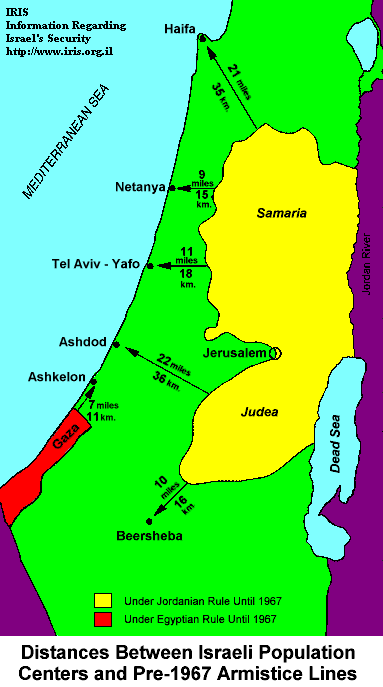
Finally, we all know that Israel won the war, not only because it survived, but also because it expanded into what are now the “1967″ borders. Since Israel won, the Arab lost, right?

Well, that depends on which Arabs you mean. See, not a single Arab state lost any territory in the 1948-49 war. In fact, Jordan and Egypt actually gained territory in the war’s aftermath: Egypt took the Gaza Strip, and Jordan took the West Bank. Arab “Palestine” ceased to exist, and Israel now had two hostile neighbors inside the old British mandate.

So while Israel certainly won, it would be hard to call Egypt and Jordan losers. Nor could Israel call itself secure with the 1949 armistice. It had the unusual support of both the U.S. and the U.S.S.R., something that just about everyone in the region knew wouldn’t last.

It didn’t. When Egypt’s monarchy fell in 1952, the nationalist president Gamal Abder Nasser quickly sought to play the superpowers against each other. Meanwhile, the concern about the Communists getting footholds in the Middle East led American and British diplomats to build alliances with Jordan, Iraq, and the Saudis (among others), three of the nations that had put men into battle against Israel, whose position began to look increasingly problematic from a geopolitical perspective.

In time, though, Nasser ensured that Israel did have friends. Britain was aghast at Nasser’s nationalization of the Suez Canal, while France was alarmed at Nasser’s support for the independence movement in Algeria (which France considered part of itself). Both were looking take action against Nasser, while Israel was watching its Suez shipping constantly harrassed by Egypt. In 1951, monarchist Egypt was condemned for this by the United Nations Security Council (Soviets included), but Nasser had ensured that the Soviets take no such position by 1956.

So, for various reasons, Israel, Britain, and France all wanted to take action against Egypt, although the British and French would austensibly intervene as neutrals merely to “protect” the Suez Canal from turmoil. On the ground, it all went as planned: Israel quickly took the Sinai Peninsula from Egypt and an Anglo-French force controlled the canal. Meanwhile, the other Arab states largely sat 1956 out militarily, although they raised holy h*ll diplomatically.

It was the reaction of the superpowers that revealed a world changed. Nikita Krushchev all but declared Israel a colonialist throwback and threatened Soviet military intervention if the UK, France, and Israel didn’t withdraw. More quietly, Eisenhower leaned hard on the UK and France (including refusing to back fill a Saudi oil embargo of them until they withdrew from Egypt), and established himself as the only American president to ever oppose Israel in wartime.

The trouble for Israel was this: Ike was only the second American president she had seen, and it was clear he was not fond of her.

In the aftermath of the second war, Israel was very isolated and alone. Forced by the UN in 1957 to go back to the 1949 boundaries, she had no reason to believe that her Arab neighbors would allow her to remain in them for a month, let alone for a decade. as the world had united against her.

As it was, Israel’s would be conquerers were beset with internal turmoil and (in Egypt’s case) intra-Arab ambition. Iraq succumbed to a military coup in 1958; Syria dissolved itself into Egypt under the United Arab Republic, which freaked out Jordan and Lebanon – in part because both had pro-Nasser factions within.

Yet for Israel in 1960, all of this just seemed a temporary argument over who would lead the Arab charge against them – and even worse, Nasser was winning.

At this point, Israel had fought two wars, and while she had militarily won both, none of her enemies suffered actaul losses. Jordan had gained the West Bank; Egypt had first picked up Gaza and then Syria, while Lebanon and Iraq had lost no territory. Meanwhile, internal turmoil meant a more hostile regime in Iraq, while Egypt’s star was rising in the Middle East. Add to this Soviet support for the Arabs and American suspicion of them (to the point where Eisenhower essentially endorsed Nasser’s Arab nationalism as the way of the future in 1958), and Israel looked to be in a very, very precarious position.

If anything, the 1950s should explain why Israelis are so worried today. The decade showed them that allies are fleeting (they lost both superpowers in less than five years), military success can be taken away by political pressure, and that was was in their best interest meant nothing to the rest of the world. The boundaries that now are considered so certain and permanent seemed highly fluid and likely to change – and not to Israel’s favor – just over fifty years ago.

As we’ll see in Part 2, the 1960′s led to dramatic change in the region, and led to the myths that many attach to it today.

Cross-posted to the right-wing liberal


Tags:

Contribute for Conservatism!

Share this post

  • Subscribe to our RSS feed
  • Share this post on Delicious
  • StumbleUpon this post
  • Share this post on Digg
  • Tweet about this post
  • Share this post on Mixx
  • Share this post on Technorati
  • Share this post on Facebook
  • Share this post on NewsVine
  • Share this post on Reddit
  • Share this post on Google
  • Share this post on LinkedIn

About the author

D.J. McGuire

Former candidate for Board of Supervisors in Spotsylvania, current blogger, economics teacher, and long-rumored windbag. There are two causes closest to the heart: steering the country away from the social democratic nonsense that is sinking Europe, and convincing the rest of the "rightosphere" that the NBA really is a joy to watch.

Comments

12 Responses to "Why the 1967 borders are not safe for Israel (Part 1)"
  1. Shaun Kenney May 23, 2011 00:17 am

    Edward Luttwak’s history on the Israeli Defence Forces was a great book… and this is probably the best in-brief summarization I’ve seen in awhile on Middle East geopolitics as it refers to Israel.

    Good read — looking forward to Part 2!

  2. JR Hoeft May 23, 2011 05:12 am

    Nice job, D.J. I think you just distilled about a half-semester of a graduate-level “Politics of the Middle East” course into one post!

    But I think the more relevant point is that Israel has a right to be highly skeptical of the U.S.

    Our policy on Israel is far too capricious. It changes by administration, regardless of party. It changes based on changing U.S. interests.

    Part II should be interesting.

  3. James "turbo" Cohen May 23, 2011 07:54 am

    “But I think the more relevant point is that Israel has a right to be highly skeptical of the U.S.” May I fix that for ya.. “But I think the more relevant point is that Israelis have a right to be highly skeptical of Barack Obsama.” The people do not have issues with each other, its the leadership and their core values.. and from whench those values come from. We share judeo christian roots and in this country that trumps who or what party is in power.. so far. If we allow ourselves to become the neo athiest country that dems may be guiding us towards then Israel will indeed have no friends and will be driven into the sea.

  4. SE VA MWC Alum May 23, 2011 07:58 am

    I agree with JR’s comments. In the bigger picture though a lot of our policies change from administration to administration.

    Lastly, and I am asking this as a questions, was Ike really “not too fond” of Israel or was he trying to rein in all three of his allies so as to minimize the risk of nuclear war with the USSR?

  5. Jamie Jacoby May 23, 2011 09:28 am

    Here’s the “Recovery”: http://www.zerohedge.com/sites/default/files/images/user5/imageroot/images/Chicago%20Fed_0.jpg

    What are we going to do about that?

    I know: let’s talk about Israel.

  6. LittleDavid May 23, 2011 10:38 am

    That is a pretty good summation of my understanding (and some further illumination on a few details) however I believe it glosses over one important fact.

    Before the 1948 war, there was a partition plan in which Israel would have been comprised of much less territory then she ended up with in the 1949 Armistice.

    Now, to not be accused of being unfair I will point out that in the 1948 Israel was fighting for her life in a purely defensive war.

    I also believe it glosses over the Palestinian refugee problem. It is true that many Palestinians willingly fled before the 1948 war expecting to be able to return after the fighting was over and the Jews were driven into the sea (the invading powers encouraged it), however it is also true that many Palestinians were expelled through force.

    However, other then my observation of the side-stepping of important issues, I do believe it is a fine, brief summation. I do think an understanding of what led up to the 1948 war is important, but you have to start somewhere, right?

  7. D.J. McGuire May 23, 2011 11:18 am

    LD,

    Please note my verbiage: “Finally, we all know that Israel won the war, not only because it survived, but also because it expanded into what are now the ’1967′ borders.” I think that makes it clear the 1948 partition was smaller than the 1949-67 lines.

    You have a point on the refugee issue, but I think that was a symptom of the larger issue: the non-Israeli portion of the mandate was swallowed up by Jordan and Egypt. They were the ones that made the refugees stateless, IMHO.

  8. LittleDavid May 23, 2011 11:41 am

    DJ,

    If you think the Gaza and the West Bank comprised as much territory as that which was supposed to be Muslim in the partition I believe you are mistaken.

    You can see a map of the proposed partition here:

    http://en.wikipedia.org/wiki/United_Nations_Partition_Plan_for_Palestine

    My understanding might be lacking, but it is that those areas proposed to be Muslim in the partition once had majority Muslim populations.

  9. Not Netanyahu May 23, 2011 14:28 pm

    Livni: PM is jeopardizing Israel’s relationship with US

    http://www.jpost.com/DiplomacyAndPolitics/Article.aspx?id=221472

  10. valentinus May 23, 2011 22:12 pm

    No, Negation of Netanyahu,

    Obama is jeopardizing Israeli security for the usual leftist ideology. Why don’t you look up the beliefs of his buddies in Chicago, the Ayers family, not to mention his bud at U of Chicago?

    Can’t trolls think up more original names??

  11. D.J. McGuire May 24, 2011 15:01 pm

    LD,

    “If you think the Gaza and the West Bank comprised as much territory as that which was supposed to be Muslim in the partition . . .”

    That’s not what I said at all. Read it again, “Israel . . . expanded into what are now the ’1967? borders.”

    So, yes, any “Palestine” would have been smaller in 1949 than the Arab piece of 1948, but there still would have been one, but for Egypt and Jordan.

  12. LittleDavid May 29, 2011 09:07 am

    DJ,

    I was attempting to rebut your paragraph: Well, that depends on which Arabs you mean. See, not a single Arab state lost any territory in the 1948-49 war. In fact, Jordan and Egypt actually gained territory in the war’s aftermath: Egypt took the Gaza Strip, and Jordan took the West Bank. Arab “Palestine” ceased to exist, and Israel now had two hostile neighbors inside the old British mandate.

    I sensed an attempt to emphasize that two external, invading states gained territory while not pointing out that those who follow Judaism ended up with more under the 1949 armistice with those who happened to be Muslim ending up with less. Perhaps I did a poor job of that.

Leave your response

The comments section is for meaningful discussion. Readers are reminded to post comments that are germane to the article and write in a common language that steers clear of personal attacks and/or vulgarities.

Please take a moment to review our comment policy.