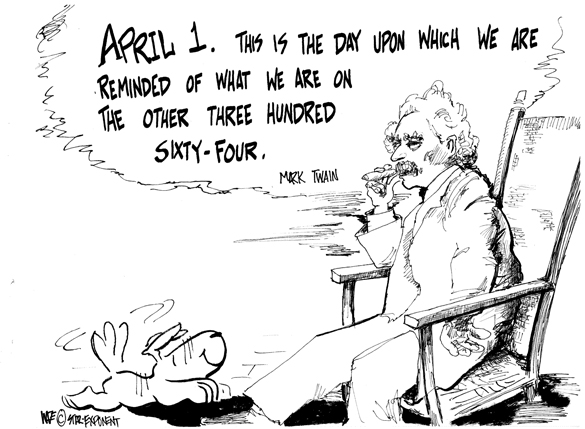
APRIL 1!
By Wade Brumett | Friday, April 1st, 2011 | Catch-AllTags:
About the author
Wade Brumett
Recent graduate "school of hard knocks", student of the world, class in session daily. Scout and I learn daily new tricks, develop bad habbits, and make new friends. Come and study with us!


We're 75% there! Thank you to everyone who has so far contributed! Just $2000 to go!
Comments
6 Responses to "APRIL 1!"
Too bad this story isn’t an April 1st story.
http://www.mcclatchydc.com/2011/03/28/111161/states-broke-maybe-they-cut-taxes.html#ixzz1IHaselGo
Looks like the Tea Party/”small government” people don’t understand reality or economics.
History of April fools day.
Not sure if this is factual, but I heard it on the History Channel.
Apparently, the new year was not always January 1st. Sometime back after our forefathers colonized North America, the Pope in the Vatican decided the new year would begin January 1st which was a change from up till then had been later in the year.
All the European powers eventually went along with the Vatican, but the free spirits in the European colonies in North America rebelled and stuck to the old. In time, those who still insisted on the old date for the change of the year despite everyone else adopting the new one were described as the April fools.
According to: http://en.wikipedia.org/wiki/April_Fools%27_Day All Fools’ Day is an international event going back to 536 BC. It was always one of my twin brother’s and my favorite days and we always found ways to one up each other. By the way, April Fools’ jokes are supposed to be done in the morning, supposedly it’s bad form to play pranks in the afternoon.
“Iranians play jokes on each other on the 13th day of the Persian new year (Norouz), which falls on April 1 or April 2. This day, celebrated as far back as 536 BC, is called Sizdah Bedar and is the oldest prank-tradition in the world still alive today; this fact has led many to believe that April Fools’ Day has its origins in this tradition.
The April 1 tradition in France and French-speaking Canada includes poisson d’avril (literally “April’s fish”), attempting to attach a paper fish to the victim’s back without being noticed. This is also widespread in other nations, such as Italy, where the term Pesce d’aprile (literally “April’s fish”) is also used to refer to any jokes done during the day. In Spanish-speaking countries, similar pranks are practiced on December 28, día de los Santos Inocentes, the “Day of the Holy Innocents”. This custom also exists in certain areas of Belgium, including the province of Antwerp. The Flemish tradition is for children to lock out their parents or teachers, only letting them in if they promise to bring treats the same evening or the next day.
Under the Joseon dynasty of Korea, the royal family and courtiers were allowed to lie and fool each other, regardless of their hierarchy, on the first snowy day of the year. They would stuff snow inside bowls and send it to the victim of the prank with fake excuses. The recipient of the snow was thought to be a loser in the game and had to grant a wish of the sender. Because pranks were not deliberately planned, they were harmless and were often done as benevolence towards royal servants.
In Poland, prima aprilis (“April 1″ in Latin) is a day full of jokes; various hoaxes are prepared by people, media (which sometimes cooperate to make the “information” more credible) and even public institutions. Serious activities are usually avoided. This conviction is so strong that the anti-Turkish alliance with Leopold I signed on April 1, 1683, was backdated to March 31.
In Scotland, April Fools’ Day is traditionally called Hunt-the-Gowk Day (“gowk” is Scots for a cuckoo or a foolish person), although this name has fallen into disuse. The traditional prank is to ask someone to deliver a sealed message requesting help of some sort. In fact, the message reads “Dinna laugh, dinna smile. Hunt the gowk another mile”. The recipient, upon reading it, will explain he can only help if he first contacts another person, and sends the victim to this person with an identical message, with the same result.
In Denmark, the 1st of May is known as “Maj-kat”, meaning “May-cat”, and is historically identical to April Fools’ Day. However, Danes also celebrate April Fools’ Day (“aprilsnar”), and pranks on May 1, are much less frequent.
In Spain and Ibero-America, an equivalent date is December 28, Christian day of celebration of the Massacre of the Innocents. The Christian celebration is a holiday in its own right, a religious one, but the tradition of pranks is not, though the latter is observed yearly. After somebody plays a joke or a prank on somebody else, the joker usually cries out, in some regions of Ibero-America: “Inocente palomita que te dejaste engañar” (“You innocent little dove that let yourself be fooled”). In Spain, it is common to say just “Inocente!” (“Innocent!”). Nevertheless, in the Spanish island of Menorca, “Dia d’enganyar” (“Fooling day”) is celebrated on the 1st of April because Menorca was a British possession during part of the 18th century.”
And of course the Easter is a celebration of the pagan god of Esther, right? Christian church steeples are actually a celebration of one pagan god or another and are actually phallic symbols.
The History Channel made a pretty good case. One Pope was convinced the then established Julian calender had fallen off the actual change of seasons. He dictated that 10 days would be wiped off the calender to get the seasons back in line with the calender. He shortly thereafter changed the beginning of the New Year to January 1st.
Not sure the other less then certain claims of the origination of April Fools Day serves as anything more then throughout history, and various societies, it proves everyone likes a good joke.
For some reason I thought that March was at one time the first month. Think “Sept” ember, “Oct” ober, “Nov” ember, “Dec” ember and where those months fall in the year.
There were lots of great pranks out there today. Being an old soldier, this one was my personal favorite. Just goes to show that the guys at Fort Fumbles haven’t completely lost their sense of humor.
http://www.army.mil/-news/2011/04/01/54202-stetson-hat-to-be-new-army-standard-headgear/index.html?ref=home-headline-link0
Leave your response