Time to end statewide conventions
By Brian Schoeneman | Thursday, September 23rd, 2010 | Politics
Conventions are a bad way to nominate candidates. I’ve felt this strongly for a long time now, and having participated in two, my feelings were confirmed. I was at the 2008 convention where Jim Gilmore narrowly defeated Bob Marshall for the honor of losing to Mark Warner for U.S. Senate and also at the 2009 coronation for Bob McDonnell, where I sat through a couple of hours of confused balloting for the Lt. Governor and AGs. Conventions are a waste of time, they’re a waste of money, they’re undemocratic, they aren’t a good way to prepare candidates for the general election and they have the potential of yielding an unelectable crop of candidates. It’s time that we move to a statewide Republican primary for our statewide candidates.
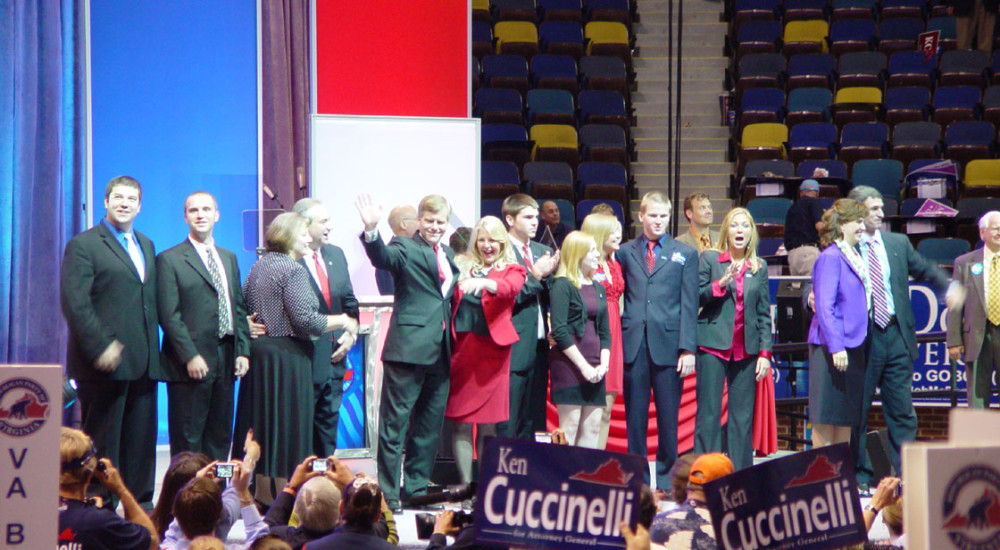
Attorney General Ken Cuccinelli has recently proposed increases to the fees charged to candidates who wish to be put before the Republican nominating convention (and check out J.R.’s post on it here). Right now, the filing fee is set at 4% of the salary of the office being sought. Last year in 2009, it was set at 2%. The 2% number mirrors the amount charged by the state board of elections as a filing fee in primaries. Cuccinelli wants to increase the filing fees to $50,000 for gubernatorial candidates, and $25,000 each for AG and Lt. Governor. The 2009 convention was criticized because it was expensive – which anyone who was there could tell you, between the Richmond Arena itself, the sound system and light show, all the decorations, etc. it had to cost a lot. And the entire cost was born by the Party.
Let’s get the politics out of this first – clearly, this proposal benefits Cuccinelli, who likes conventions and has demonstrated he knows how to win them. Conventions are great for candidates who are popular with party activists, as Marshall’s near-defeat of Jim Gilmore in 2008 demonstrated. Plus, with a candidate like Ken who knows how to fundraise, the $25,000 or $50,000 amount isn’t going to be a problem. So regardless of what non-political reasons Cuccinelli has for suggesting the convention, he knows that it’s a strong point for him and if he chooses to take on Bill Bolling in 2013, he’ll be at an advantage if RPV decides to host a convention.
We shouldn’t do that. It’s time to end the convention nonsense and bring the RPV kicking and screaming into the 20th century.
Primaries are the way to go. The Democrats have figured this out. The national party has figured this out. Most states have figured this out. There’s no reason for us to keep burying our heads in the sand and pretending that conventions are better. There’s a laundry list of downsides to a convention. First, they exclude significant portions of the Republican electorate that either can’t afford to go to Richmond or can’t get away for a weekend to do so – including our servicemen and women overseas. I’m a party stalwart and I’ve been to two conventions, but I would rather take ten minutes to vote (or spend all day poll watching as I have since 2008) than drive to Richmond and kill an entire weekend. Primaries don’t cost the party a dime – they’re paid for by state and local governments. And since the Democrats invariably have a primary, it won’t cost the taxpayers significantly more to host a primary on the same day, either. By hosting the Democratic and Republican primaries on the same day, you reduce the chances of Democratic interference with our nominating process – the bugaboo that most convention supporters love to throw out.
Most importantly, you get more viable general election candidates from a primary. Winning a convention requires a completely different skill-set than winning a primary. All you need to be able to do is gather a handful of people from the various counties across the state (the larger the county, the better as our votes are weighted at the conventions) and you can pull off a convention win. Even Jeff Frederick could handle that. Winning a primary requires statewide campaigning – the same kind of campaigning you would have to do in the general election. It forces candidates to get their operations and organizations ready for prime-time far ahead of the actual election and that is a benefit, not a detriment. It also has a tendency to weed out candidates who have no possibility of winning statewide. Bob Marshall would not have come anywhere close to beating Jim Gilmore in a primary in 2008, but he came within a hairsbreadth of winning at the convention. Primaries aren’t infallible in that regard (look at Delaware) but on the whole they are a better way to vet candidates than a convention.
The conventionistas will invariably call me a RINO for wanting more electable statewide candidates, but I have to remind them that electable doesn’t mean moderate. It means electable. And for those who are concerned that primaries will kill off unconventional candidates, all I need to do is point you at Delaware again. Conservative candidates can win, just like moderates can win. But what can’t happen is an off-the-wall candidate rounds up a couple hundred friends, signs them up and parcels them off to the convention to give him a victory. Granted, Cuccinelli’s idea of raising the convention fees would preclude that, assuming that the off-the-wall candidate isn’t rich. I would rather make it difficult for rich and poor off-the-wall candidates to get elected, frankly.
I can understand why the AG wants a convention – it’s in his best interests, and I can respect that motivation. But it’s not the in the best interests of the Party or the Commonwealth. It’s time to end the conventions and go to statewide primaries.
Tags:
About the author
A veteran political professional, a long-time Republican party activist and new attorney, Brian W. Schoeneman has been offering his opinions at Bearing Drift since 2010. He serves on the Board of Virginia Line Media, LLC, which operates Bearing Drift and spends his days representing the U.S. Merchant Marine in Washington, D.C. He hails from Fairfax County, Virginia, where he lives with his wife and son.


Comments
41 Responses to "Time to end statewide conventions"
Brian: several points on your excellent post:
1: conventions are a way to bring together people from all over the state to meet face to face. For example, at the 2008 convention, I met: Bulletproof Monk, Sen. Robert Hurt (my candidate for 5thCD Congressman) & Halifax Commonwealth’s Atty Kim Slayton White. And I became re-acquainted with members of our own Lunenburg (& other Southern Va) delegation.
2: There is a simmering feud in the 5thCD over the primary held to select Robert Hurt as our nominee to face Perriello. Many wanted a convention. A convention may very well have nominated one of several people who do not have what you call the “skill set” to run a big campaign for national office. So in this respect, I heartily agree with you: a primary is the way to go.
3: but someone else will mention this more adroitly than I, but wasn’t Creigh Deeds et al nominated by primary?
Kelley, conventions do provide that opportunity, but so does the RPV Advance. There’s no need to nominate candidates at an event to get folks together.
Sure, Creigh was nominated in a primary, but then again I don’t think there was a single Democrat out there who could have beat Bob McDonnell. And while our candidates all won and were all chosen by convention in 2009, 2009 was a major Republican year. I think even Patrick Muldoon would have won if he’d have been nominated.
This isn’t necessarily related to whether we should or shouldn’t have a convention, but – what a terrible argument…
“Most importantly, you get more viable general election candidates from a primary.”
Forget principled philosophy, right? The last thing we need in the Republican party is people like Jim DeMint, B.J. Lawson, Rand Paul, Clint Didier, Ken Cuccinelli and Ron Paul. Those crazy folks who won’t make the compromises simply aren’t viable candidates…!!
The reason the Republican party faced desecration in 2008 and why it will further deteriorate is due to the fact that we elect these so-called ‘viable’ candidates as opposed to people that principally represent the party platform. George W. Bush, Lindsey Graham, Eric Cantor and other progressives within the party are the key attribute to our own self-destruction.
J. Christopher, that’s a perfect example of what I’m talking about. Ron Paul has a principled philosophy, but he’s unelectable nationally. Should we nominate him for President simply because of his ideology?
We can run however many ideologically pure candidates you want, but if they can’t beat the Democrat, what’s the point? There are no prizes for second place – unless you consider watching the Democrats run the country into the ground is a prize.
I would also point out that Rand Paul and Jim DeMint both won party primaries for their nominations.
And while you may not like Bush, Graham and Cantor, the one thing they all have in common is that they won. You may not like things they’ve done, but I can assure you that you’d like what their Democratic opponents would have done in their place far less.
Electability matters and there’s more to electability than simple policy stances.
@Brian:
You’re pointing out the ‘primary’ problem within the GOP. We are nominating people based on electoral viability – which has contributed to the destruction of our party. This year’s resurgence of the GOP isn’t based on a candidate’s viability, but on the presumption that we’re headed for major social, economic and political problems if the status quo is to continue.
Based on your statements, I pose a question; why have a Republican creed? What is the point of having a platform to run on if you blatantly and deliberately disregard it once elected?
Under the platform of George W. Bush, we were barely indistinguishable from Democrats – if not identical. Thanks to him and the Congress, we were blessed with the Medicare Prescription Drug Program, No Child Left Behind, TARP, the automotive bailouts, a stimulus package, amongst many other socialistic programs – all paid for by deficit-spending.
I’m interested in getting rid of these progressives, restoring individual liberties, lowering taxes, cutting spending and eliminating regulations.
It sounds like you and I are talking about two different Republican parties. If the Republican party isn’t based on a platform, am I in the wrong place?
J. Christopher, we’re a big tent party. You do not have to subscribe to every plank in the Republican platform to be a Republican or to run as one. We run Republicans in every state in the union and every state is going to have its quirks and local flavor and no national platform is going to fit everyone. A Republican in Maine is different from a Republican in Mississippi – the same way that a Democrat in California is different from a Democrat in Louisiana.
Nominating candidates who can win is not a problem. If we didn’t do that, we wouldn’t be a party at all. This year’s “resurgence” is based on the fact that the Democrats have angered the electorate – but I have to point out that this years resurgence hasn’t happened yet and if we throw away our chances of winning seats by putting flawed candidates like Christine O’Donnell before the voters, it won’t happen.
We have a Republican creed because it binds the party together. There’s nothing in the VA GOP creed that I disagree with – nor would most Republicans. But there’s a lot of wiggle room within the creed, which is necessary if we are to be a national and not a regional party.
You can also thank George W. Bush for the largest tax cuts in U.S. history, protecting the country from terrorist attacks, cutting regulations left and right and John Roberts and Samuel Alito. You think you would have gotten that from Al Gore or John Kerry? Nobody is perfect, but I doubt you’d have many Democrats saying they thought Bush was one of them. We shouldn’t be saying that either.
I’m interested in getting Republicans back in the drivers seat, so we can keep taxes low, cut spending and ensure balanced regulation that doesn’t hinder business but keeps Americans safe and the economy stable.
We don’t have to be talking about two different parties. The Republican party is more than just a platform.
Chris, the answer you are looking for is yes.
@ Brian
It’s obvious we have different shades of folks within the GOP, but it doesn’t make any sense to have a party platform if we blatantly disregard it time and time again.
The 2008 election cycle should be looked at as a wake up call for the Republican party. We abandoned our principles and we paid the price. If we don’t live up to our creed once we regain control over Congress, we’ll be shut out by the Democrats once again. Electing folks like Bush, Graham and Cantor will do nothing but create more problems for the future of the party.
I don’t really think we need to get into a big discussion on George W. Bush… It’s clear to me and most true conservatives that he was a progressive that nearly put the GOP six feet under.
Bush protected the country from terrorist attacks? Are you kidding me…?
I think Jim DeMint said it best; “I’ve been in the majority with Republicans who didn’t have principles, and we embarrassed ourselves and lost credibility in front of the country. Frankly, I’m at a point where I’d rather lose fighting for the right cause than win fighting for the wrong cause.”
I’m interested in getting Republicans back in the drivers seat so long as they adhere to the party platform and, most importantly, the U.S. Constitution.
Brian: I tend to agree with you that primaries are the best way for both parties to nominate their candidates.
Re Cuccinelli: I don’t think it makes much difference. If he decides to run for governor he’d easily beat Bolling in a Republican primary. Granted, he’d win even easier in a convention.
Brian,
You are spot on about conventions versus primaries. Conventions are the last vestige of the “smoke-filled rooms” of the 19th Century. They are dominated by party activists and un-democratic as a result. As you have pointed out, not every voter has the time, money, and other resources to travel to Richmond for a convention. If that is how a party wants to choose their nominees, they we might as well have a poll tax.
BTW, I’m glad that you brought up Christine O’Donnell. While there are several reasons why she defeated Mike Castle, the fact that Delaware has closed primaries was certainly among the major ones. Closed primaries force moderate Independent voters to either declare one party affiliation, usually months in advance before the candidates are even known, or not vote in the primary at all. Most Independents in Delaware would likely register as Democrats simply because of the dominance of that party in that state. In an open primary, they would have crossed over and voted for Castle.
While many party loyalists don’t like open primaries, the fact is that they tend to produce more electable candidates rather than ideologues. I don’t think that it is too much of a stretch to say that closed primaries in Delaware might very well cost Republicans control of the US Senate in November.
Brian, couldn’t agree with you more. With conventions, the candidates are, obivously, selected by those delegates in attendance. The vast majority of those attending the day long conventions which may be hours from home are the right wing nuts who have no lives outside politics. As right wing nuts, they’ll vote for extremist candidates who are not nearly as electable as those chosen by a more representative cross section of the party such as through a primary.
… I must be absolutely insane.
J. Christopher,
You are certainly not insane, but your ideals for an unswerving loyalty to all principles of a political platform is symptomatic of why the Republican Party has hemorrhaged all the Reagan Democrats it gained in the 80s over the past 20 years, making it the smallest voter block in the country after Independents and Democrats, respectively.
Both major political parties have non-waiverable litmus tests for their national candidates. However, the Republican Party has pushed those measures of fitness to a much lower level. Blue Dog Democrats are still pretty common in the Congress and lesser offices. But, moderate Republicans are vanishing like the Hindenburg–witness Mike Castle.
It is fine to have a political party with narrowly defined principles that are not optional to qualify for membership, just as long as you are satisfied to forever be the minority party.
don’t mention favoring a primary over convention to TEA party activists in the 5th CD. They are still smarting from the primary where Robert Hurt won over many other candidates.
kelley,
That proves Brian’s point, doesn’t it? With a convention, the Tea Party candidate might have prevailed, leaving VA-5 almost certainly in the Democratic column in November. Hurt, with a broader appeal to the most likely voters than an activist with a dedicated following, can swing that seat back to the Republicans.
Hi….excuse me. Fiscal conservatives? Or at least we claim to be…
The Party bears the cost. Or the taxpayers bear the cost.
If we’re fiscal conservatives, choosing our nominee HAS to be paid for by the Party. To bill the taxpayers across the state for choosing who gets the R is absurd and runs contrary to EVERYTHING we claim to stand for (private (party) enterprise works best, vs government run (taxpayers, fiscal conservatism, allows Republicans to choose Republicans, etc)
I’m shocked there’s so many agreements on this thread. I agree with J Chris…I must be insane.
I have to say im a fan of conventions.
D.J.-well, there’s actually no reason at all that the parties couldn’t be — in fact they should be — required to reimburse the state for the cost of running the primary election. Does that satisfy your fiscal conservatism?
RINO-esque neoconservatism is on its way out, folks.
D.J., fiscal conservatism doesn’t require us to choose conventions over primaries. As I noted, the Democrats already do this so the additional cost to add a Republican ballot is negligible. And there’s no reason why the party can’t donate the cost of the primary to the Commonwealth. The Department of Taxation takes donations.
Republicans will still choose Republicans.
Those are bad reasons to choose an undemocratic candidate selection system.
I don’t think either of you are insane, but one of you did call George Bush progressive…
If you don’t think George W. Bush was a progressive, you’re severely misguided or totally blind. Period.
Right. In what alternative universe can GWB even spell “progressive.”
Fiscal conservatism is the lamest excuse for choosing a convention over a primary. The expense of a primary is a rounding error in the state’s budget. Besides, in the order of budget priorities, nothing, and I mean nothing, is more important than preserving the democratic process.
I think that some posters here are grasping at straws. The truth of the matter is that conventions, much like off-year elections, allow the party apparatus to more tightly control the political process and who participates in it. Therefore, it is inherently undemocratic, concentrating power disproportionately in the hands of a few activists and not the general voter population.
I am not surprised that those who currently benefit the most from the system would work the hardest to preserve it.
Steve and Brian,
No, ‘donating’ or having the Party reimburse the Commonwealth for a primary does not satisfy the fiscal conservative. The 2nd District primary alone cost nearly a quarter million dollars in taxpayer dollars. A statewide would be exponentially more expensive, virtually bankrupting the state party anytime a statewide primary would be necessary. Costs of the convention, illogically argued in the article above, are covered by not only the party but also the candidates and donors. It is vastly cheaper.
And in an open primary, it’s impossible to guarantee that Republicans vote for Republicans. We don’t have party registration, so how do we allow Republicans to choose a Republican nominee? A closed nominating process is the only option.
Lloyd, your name is apt. You are an idiot. We’re not a democracy. And nominating the nominee is NOT part of the preservation of the democratic process.
The article above does not explain why primaries are better. Not one comment so far has explained why. But I hate to break this to all of you, but conventions are conservative in principle, which is why the Party and conservatives prefer them and will continue to do so, regardless of Brian’s fear of Cuccinelli.
+1 J Christopher Stearns.
Scuze me but may I clarify.. Bush conservative values did not hurt the GOP.. it was the GOP congress channeling progressive values through Bush was it not? W and the party he represented had both values at different times to varying degrees, call em selective progressives if you want. But, the difference is that Obama is the talking head of a progressive socialist movement all of the time. We voted for the less worst candidate and Kerry was worser. I’m pessimistic and remain convinced the selective progressives in the GOP are many and will not be sent home.. And forgive me Messrs. Nye & Rigell but I am concerned that VA-2 just might put one of you back in office this fall.
Bush was at times a Progressive inspite the fact that he campaigned as a republican. He was re-elected because people were selecting who they believed was the more trustworthy or likeable of two. The man was an incompetent president in the minds of many and he meant well but Obama’s entire potus career has been one epic mistake after another.
Ending statewide conventions will not eliminate Establishment driven selection of candidates will it?
D.J, as I already noted twice and you’ve ignored twice, the Democrats already hold statewide primaries. The costs will be split between the parties. We already bankrupted the party with the 2009 convention – that’s why Cuccinelli suggested increasing the fees. So what’s the difference?
It may be “vastly cheaper” to hold a convention, but it’s also a vastly worse way of selecting candidates. The numbers of non-Republicans who cross over to vote in primaries is miniscule. That’s a boogieman, not a real issue.
Read the article again. I explained why primaries are better. There’s nothing inherently conservative about conventions. Party activists who don’t trust your average Republican voter may prefer conventions, but I was under the impression that, especially with the rise of the Tea Party, leaving the decision over who our candidates are to a smoke filled rooms of party insiders was a thing of the past.
D. J.,
Did you really mean to say that the Republican Party is not a democracy or did I misunderstand you?
If it is not a democracy, then what is it, Communism or the Mafia?
When a select few party leaders disproportionately control the selection process of nominees, then where does that leave the voters in a two-party system when the general election is held?
You would do well to read the history of your own party and find out what the political dynamics were that allowed the Republican Party to replace the Whigs in our two-party system.
D.J., quick, name an open primary where the outcome was affected by crossover voting.
So your only critique is that it costs the state money for voters to participate in the process of selecting nominees?
@ HisRoc
Technically, the United States is not a democracy. We’re a constitutional representative republic, which takes into consideration contractual obligations – such as property rights, gun rights, etc. – as opposed to the will of the masses.
DJ,
“[N]ominating the nominee is NOT part of the preservation of the democratic process.” WTF?! Then what is?
J. Christopher,
I see. We are not “technically” a democracy. Our Constitution holds that power is derived from the function of being an elected representative and not derived from the People, or “the will of the masses” as you so quaintly put it. And just where did you study Political Science, The University of Phoenix or some other diploma mill?
Your assertion is as twisted as the logic used by tax protesters that they are not required to pay income taxes because the United States has a “voluntary” tax system.
@ HisRoc
Insult me as you wish and take it how you will. Facts are facts and your denial of those facts only furthers my credibility and enhances your disconnect with conservative ideals.
Your partisan idealism is what ultimately destroys conservatism and the prospect of individual liberty in the future of America.
J. Christopher and DJ simply prove the point the rest of us are making – people attending conventions are too stupid to be selecting candidates.
What Lloyd said.
J. Christopher, if you think that what I posted was an insult, then you have an incredibly thin skin. No insult was intended; I was seriously questioning your source of information.
If your viewpoints represent “conservative ideals,” then trust me when I tell you that I relish being as disconnected from them as I possibly can be. As for my “partisan idealism,” whatever that means, I would like you to help me understand it better so that I can maximize its effect on destroying your concept of conservatism and individual liberty.
Brian,
I will have to disagree with you on this one. While I am open to a primary process, and primaries have certain advantages, so do conventions.
1) In a primary the candidate will not necessarily build a statewide organization. For instance if I am running for the GOP nomination and my voting base is in Hampton Roads, then I will spend much time and money in Hampton Roads but not necessarily in Central VA. In a convention, candiates must build a county by county operation (albiet small).
2) Conventions do not necessarily produce losers. Many centrist GOPers spent years saying that Ken Cuccinelli would be a disaster as a statewide candidate, they said that he was too conservative. Yet he did just fine. As a matter of fact, the 2009 convention produced three winners. It is hard to make the case that conventions produce “unelectable” candidates.
3) There is a popular myth that centrists are somehow docile and are not as likely to show up at a convention. However, I think that activism on the part of centrists such as yourself and other notable GOP commentators and activists shows that while centrists may be moderate in their political views, that does not mean that they are moderate in the level of their political activism.
So while I am not against a primary, I actually believe that a convention may be more benefitial for the party.
I have also heard of a caucus system suggested, whereby each unit meets in its home county on a particular night and sends the results to a central location in Richmond. That is similar to how they do things in Iowa’s presidential caucuses. That serves to generate grassroots activism and allows candidates to identify key supporters in the various counties.
How much does a primary cost a county or the state ? As conservatives this should be a question we ask also.If we have had a convention in the 5th the candidate that won wouldn’t have had to spend all his cash in a primary that gave the Democrats alot of talking points.Robert Hurt was almost broke for two months after the primary.Im not sure a convention would be the most conservative thing to do.
[...] This post was mentioned on Twitter by Bearing Drift, Martell Thornton. Martell Thornton said: Time to end statewide conventions | Bearing Drift: Virginia …: Most importantly, you get more viable general ele… http://bit.ly/dvOlbh [...]

Brian, Your notion that Jim Gilmore fared better against Mark Warner than Bob Marshall would have is severly flawed. I worked the phone banks that year and while there was a high level of support for McCain and Cantor (I am in Hanover County), there was very little support for Jim Gilmore, I was stunned at the lack of enthusiasm. Bob Marshall gets conservative voters excited, and while I won’t argue that he would have won the election, I think he would have gotten more votes than Gilmore who ran a very uninspiring campaign.
I like the idea of educated Republicans convening to nominate the best candidate. People that take the time and effort to travel to a convention are more likely to do the homework necessary to select the best candidate to represent the party than a casual primary voter.
Your arguement about election preparation is baseless. Ken Cuccinelli built a solid base of convention delegates throughout the commonwealth who then became his campaign organization raising money and building support for Ken. I think one could argue that McDonnell benefitted as much or more from Cuccinelli’s coat tails as Ken did from Bob’s.
in the end, this debate is always considered way more important to uber-insiders and factions that it is to the general voting public. What’s an average statewide primary turnout? In the end its about the candidates themselves and the campaigns they run . . . this primary vs. convention debate is just a strawman used by both sides to try and antagonize the other and get their kind of Republican nominate. But neither method guarantees either outcome. In the 5th the more moderate Hurt came out of the primary, but in the 11th the more conservative Fimian came out of the primary. In 2008 the more moderate Gilmore defeated the ultra-conservative Marshall while in 2009 conservative Cuccinelli overwhelmed moderate Brownlee.
Whether its a convention or a primary, the winners are always the candidates with the best campaign and the best message that connects with most Republicans.
I’ve never seen an issue that means so little get debated so much as convention vs. primary. Weak candidates are weak candidates, strong candidates are strong candidates . . . and that holds true whether the nominee comes from a convention or a primary.
[...] missed it, a riveting discussion is occurring in response to Brian Schoeneman’s recent post “Time To End Statewide Conventions.” In the comment section, several readers are lamenting the tendency of “establishment [...]
Leave your response
The comments section is for meaningful discussion. Readers are reminded to post comments that are germane to the article and write in a common language that steers clear of personal attacks and/or vulgarities.
Please take a moment to review our comment policy.